
I still remember Halloween night, 2018. As my family of 10 was just getting home from trick-or-treating, my sister mentioned “hey, so there’s something interesting going on in the Undertale fandom…”
The kids all watched as I followed her directions to a strange website linked by the official Undertale Twitter page: deltarune.com. The term was familiar — the “Delta Rune” was an obscure lore tidbit in Undertale, which didn’t quite fit nicely into the main plot — so its usage here was curious. The website gave us an installer for a “SURVEY_PROGRAM,” with instructions not to talk about what was in it for 24 hours and a cryptic one-line license agreement: “YOU ACCEPT EVERYTHING THAT WILL HAPPEN FROM NOW ON.”
Trusting the Undertale Twitter account (and our virus scanner), we installed SURVEY_PROGRAM.EXE, ran it, and found ourselves booting into a character creation menu. Then unexpectedly having our creation discarded, and under the glare of sunlight through an autumn window, meeting our new player character for the first time…
Defying all reason, Toby Fox slipped us the opening chapter of a whole new game that Halloween. We played it through in two nights, and only then learned the true name of the game: DELTARUNE, a promise of answers to come and of a grander, deeper mystery to be revealed. It was more than anyone could ever have hoped from a moment like this, and a wonderful Halloween surprise.
But if I’m honest, I knew what the SURVEY_PROGRAM really was before it even finished installing. Because I saw the installer extracting the game’s music.
DELTARUNE is, if not a sequel per se, then certainly a follow-up to the hit 2015 RPG Undertale. Undertale’s soundtrack, composed personally by the game’s creator Toby Fox, deserves every bit of its reputation. Even ignoring the meme power of Sans the Skeleton and “Megalovania,” the soundtrack complements the game’s subversive yet sincere story with skillful, emotionally powerful composition lifted straight from the golden age of retro gaming. Undertale simply would not be a complete package without the music; of course a game like DELTARUNE, which builds on Undertale’s foundation in every way, would be the same way.
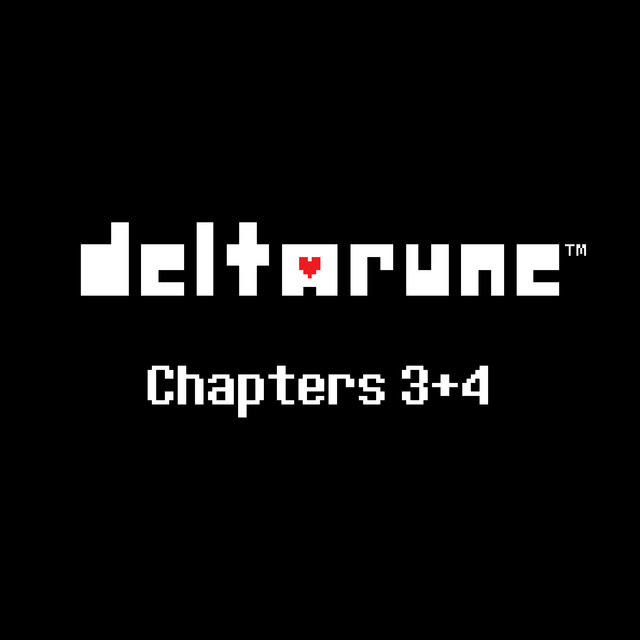
Since that first Halloween night, DELTARUNE chapters have been releasing in a slow burn, three or four years apart. In 2021, a Chapter 1 playthrough stream ended in a surprise Chapter 2 release date, just two days out. And this summer, Chapters 3 and 4 launched as the game’s first paid release. Each new chapter brings practically a full game’s worth of content, and certainly a full album’s worth of new music. It almost doesn’t make sense to cover them all in one article…
So we won’t! This is the first article of a two-part series covering the music of DELTARUNE. Today, on the ever-spooky anniversary of Chapter 1’s release, it only makes sense to cover the two demo chapters that started it all.
Spoilers ahead! Including spoilers for chapter 3, chapter 4 and the game’s darkest secrets.
One of Toby Fox’s greatest strengths — as a storyteller and as a composer — is his command of emotion. In any given moment of gameplay, he knows exactly what emotional experience will support the story best, and how to use the music to create that experience.
An early scene from Chapter 1 comes to mind… In the mysterious and out-of-place silence of an empty town, a hooded figure speaks to you under the starlight. He tells you of a legend, a legend whispered among shadows… Archaic-sounding music accentuates every moment of the terrible, awe-inspiring prophecy he unfolds to you in sepia tone:
It’s such a simple melody, yet so powerful you believe that it’s persisted through the ages. The game’s stakes and tone have been laid bare: Undertale was lighthearted through and through, but in Deltarune, the prophesied end of the world is approaching.
But the sequence isn’t over. As soon as the figure is done, the first low-ranking baddie shows up to stop you from thwarting the King’s evil plan, and you have your first fight to the tune of “Rude Buster,” the game’s main battle theme. You walk through the silent streets of the town you first entered, the lonely “Empty Town” scoring your solemn footsteps as you make your way to the Grand Door to leave this place behind forever and journey out into the unknown, never to return.
Purple grass sways in the field outside of town. From beneath the blocky treetops, you emerge into the open plain. A track name flashes across the screen: “Field Of Hopes And Dreams.” And this is the music that plays:
The journey has begun. The only way is forward. And you’re feeling good. As the first music you hear as you move from big story sequences into your first real gameplay, “Field Of Hopes And Dreams” captures the feeling of adventure, of taking that first step into the unknown with the wind at your back and your spirits buoyant. It reminds me of the opening sequence of Kiki’s Delivery Service, actually. It’s no surprise that this song was one of the most popular in the Chapter 1 days. Who doesn’t love the feeling of a new adventure?
The game never pulls the show-the-track-name trick again, but perfectly scored scenes are high in supply, and only moreso with each new chapter. “A CYBER’S WORLD?,” Chapter 2’s equivalent to “Field Of Hopes And Dreams,” first plays in sync with a funky little rhythm game sequence before hitting you with the grand panorama of Cyber City. “Cyber Battle (Solo)” is joyful and upbeat for a battle against fun-loving music rebels. “Elegant Entrance” is regal and solemn, for leaving behind the friend you can’t help in the basement of the Queen’s mansion. And across all chapters (except chapter 3), “GALLERY” never fails to make boss confrontations feel absolutely epic.
DELTARUNE may not be a sequel to Undertale, but it’s certainly in conversation with Undertale, and so there’s a bit of musical crossover on display. There’s a few instances of tracks from Undertale being reused whole-cloth — mostly for silly easter egg rooms involving Toby Fox’s self-insert mascot character, the Annoying Dog, and for Sans the Skeleton — but it’s more common to see Undertale melodies being remixed into new music for DELTARUNE, or even just alluded to in spirit. Chapter 1 is especially guilty of this — the chapter was designed to feel confusingly close to Undertale, so it takes every chance it can to bring in familiar musical trappings, whereas Chapter 2 focuses more on establishing DELTARUNE’s own identity.
Chapter 1 almost always leverages Undertale quotations to specifically bring a sense of familiarity. The strongest example of this is definitely “You Can Always Come Home,” a track which plays as the main character returns home at the ends of both Chapters 1 and 2. The entire first half of the track is a direct arrangement of “Home” from Undertale, with a slightly fuller orchestra rather than just a solo guitar (or music box). Even without the Undertale connections, the piece beautifully captures the feel of coming back to a familiar, loving family home at the end of a day — but the extra sense of familiarity that comes from knowing that guitar part, and knowing that main theme, adds a little extra for Undertale players.
This is far from the only Chapter 1 moment using Undertale melodies to bring a sense of familiarity — but more interesting are the moments which don’t directly quote Undertale, but still definitely pay homage to it. Halfway through Chapter 1’s main quest, you encounter a peaceful bake sale in the middle of the forest, not unlike a lemonade stand set up under golden neighborhood trees. This scene’s evocative and serene music, “Quiet Autumn,” is very much patterned on “Quiet Water” from Undertale. It never directly quotes a melody from Undertale, but the piece’s rolling electric piano arpeggios and overall form definitely hearken back to the somber watery caverns where “Quiet Water” plays. The two tracks carry two very different affects, yet somehow, very similar affects as well.
Before we go on, I would like to mention that “Before The Story,” the completed-chapter file select theme, is a bit of an odd case. While not technically from Undertale, it first appeared in a PS4 dynamic theme styled after Undertale’s first area, and it arranges Undertale’s main theme. It’s not clear whether this makes it an Undertale or a DELTARUNE track. It certainly fits DELTARUNE‘s file select menu well…
Are there good boss themes in DELTARUNE? You bet your bee’s bonnet there are. The guy who made “Megalovania” AND “Death By Glamour” AND “Hopes And Dreams” isn’t going to stop there, not for his next game. Chapter 2 especially is filled to bursting with awesome boss music. The chapter boss, Queen, has no fewer than two boss fights, each with unique music. The fun-loving music rebels’ attack patterns play in sync with their miniboss music. Berdly may be annoying, but we’re lucky enough to hear his boss theme, “Smart Race,” no fewer than two times in the chapter.
The one that takes the cake, though, is the secret boss theme. Each chapter to date has had an incredibly difficult secret boss hidden behind the scenes, just off the path. Chapter 2’s secret boss theme also happens to cap off a long sequence of emotional music — in this case, music supporting the emotion of fear. Sketchy deals in the garbage dump black market. Talk of [HEAVEN] from a strange man obsessed. An unnerving mechanical basement with machines you don’t understand.
And now this. Thanks to your little stunts, Spamton G. Spamton has [Becomed] NEO. And now you’re in for the roller coaster ride of your life, for your life.
This boss track isn’t just intense — it has layers. Layers of quotations. Quotations of Spamton’s own theme (good luck getting “Now’s your chance to be a BIG SHOT! Be a big, be a big…” out of your head). Direct samples of a couple of Undertale songs. Quotations of strange, incomprehensible verse that I’m still puzzling over years later. And, at 0:55…a quotation from “THE WORLD REVOLVING,” the previous secret boss theme…what the heck?
“BIG SHOT” introduced, really truly introduced, the fandom to the melody we now call the “Freedom Motif.” We’d heard it before — it forms the entire main melody of “THE WORLD REVOLVING” — but Spamton NEO’s boss fight was when we knew it for what it was. This melody is a connection between the secret bosses. With the exception of chapter 3, every chapter’s secret boss has now used this melody in at least a small way. It’s a consistent enough pattern that the exceptions are attention-grabbing, and since the release of Chapter 3, fan theories have been flowing.
We’ll talk more about connective melodies next time. For now, let’s turn our attention to even darker secrets buried within the game. DELTARUNE, it turns out, is a deep abyss. Deeper than we can fathom. And as we all know, when you stare into the abyss…
Flash back, if you will, to early gaming times. It was a different world then. If the kids on the playground told you “oh yeah, Luigi actually is real in Super Mario 64, you have to run around the fountain in the courtyard 2401 times to unlock him,” how would you know if they were lying? You couldn’t easily learn about the inner workings of the game with a quick search like you can today. You could read what other people had experienced, but you could never be certain that they were 100% right — and what if THEY were lying? Your only hope was to try it yourself, and even then, how could you be sure you hadn’t done one of those two thousand four hundred and one loops around the fountain slightly wrong at some point?
Which is all to say: did you know that it’s possible to kill Berdly in DELTARUNE Chapter 2? No, really. All you have to do is double back as soon as you get Noelle, kill every enemy with her IceShock spell, pick specific dialogue options at the shoe store… There’s even special battle music for when you face Berdly at the end. It’s not published in the OST, but you can find it in the game’s files. And you know what the most messed up part is?
It’s real.
Provably. With guides and video evidence, from multiple independent sources.
You can KILL Berdly.
The game internally refers to this sequence as the “Weird Route.” Many fans prefer the more evocative term “Snowgrave Route,” named after the ultimate spell Noelle uses to do the deed. It really seems like this route is designed to somehow break the game, go against the path that Toby Fox laid out for us to follow in the main route — which makes it very interesting that Toby went out of his way to make unique music for this obscure hidden route. Quite a bit of it, too. In fact, “Flashback (Excerpt),” the song I linked to above, was a hidden Weird Route-only song until the release of Chapter 3!
People have noted that Toby Fox seems to be able to call forth nostalgia on command. I think that’s because Toby has a uniquely sensitive eye for the experiences people share. As creepy as it is, the Weird Route hits partly because it shows understanding of who gamers are, and were, as a subculture — our shared history of going too far in our hunt for ever-deeper secrets. It’s a shout out, an acknowledgement that he sees us and knows who we are. And he’s doing this constantly. The quiet moments spent just enjoying Susie’s company by the lake. The all-too-real awkward volunteer sermon in Chapter 4. What spam email used to feel like. Not knowing how much of yourself is too much to give. Having friends for the first time in your life. DELTARUNE is a game about light and dark, but it’s also a game about what it’s like to be a person. And ultimately, except for those who look beyond the mark, it’s a deeply hopeful game. Diving into the darkness, there will be fearful moments — but there will also be hope, and ultimately you’ll emerge better for it, having changed into something greater than you were before.
The final track of the night, “Faint Glow,” perfectly captures that sentiment. Tinkling chimes, Middle Eastern flavor, a chord progression that moves in some unexpected yet beautiful ways. Against the pulsating backdrop of a grand, curlicued golden door, the file select menu beckons. What could be a greater adventure, it says, than experiencing a new chapter for the first time? And indeed, this music only scores the file select menus of chapters that have never been completed before — once you finish a file, “Before The Story” takes over to wistfully remind you of first playthroughs past.
First playthroughs are always a uniquely special experience… “Faint Glow” beckons you to have yours. Come experience the game, it says. The new chapter is waiting, it hums in swelling tones. The new chapter is waiting.
DELTARUNE is waiting.
Enjoy your Halloween, everyone. We Play It For The Music: Deltarune Chapters 3+4 drops next month.