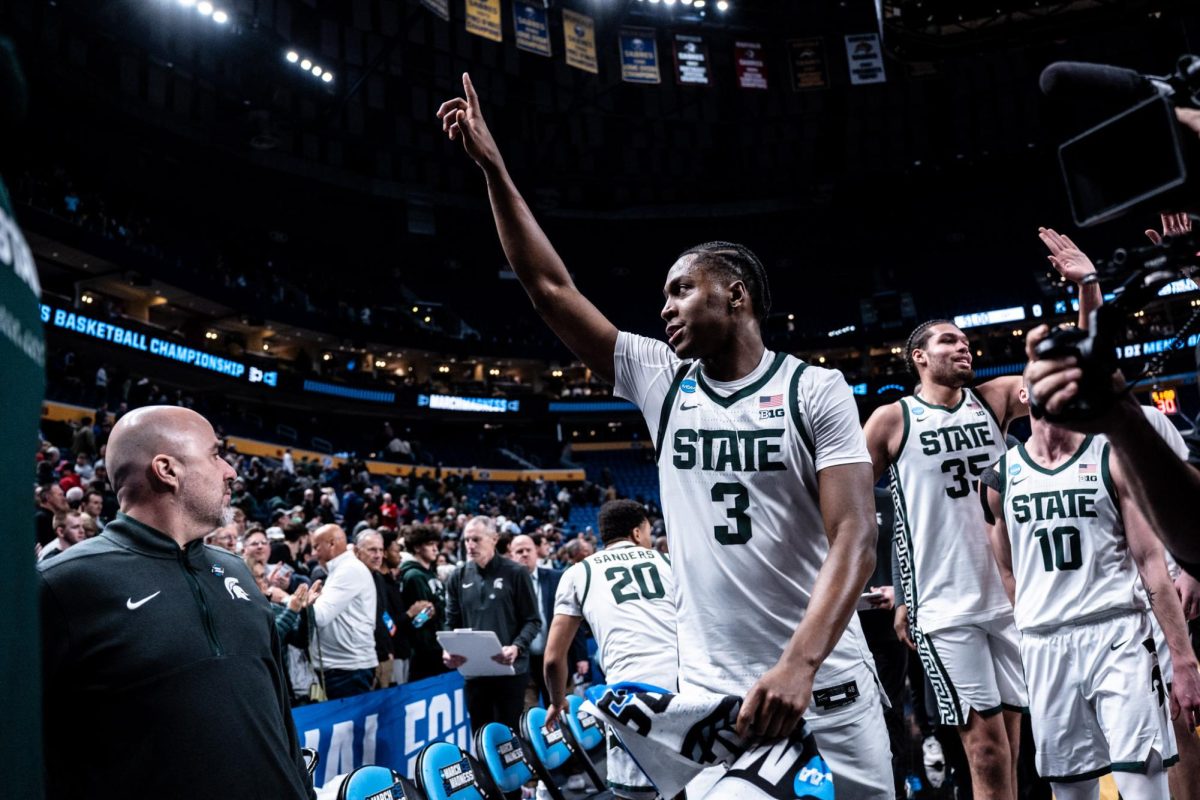

WASHINGTON – No. 3 seed Michigan State men’s basketball has a tall task ahead in order to advance to the Elite Eight for the second consecutive season. The Spartans have a matchup with the No. 2 seed UConn Huskies in the Sweet 16 on Friday night.
This is a marquee coaching matchup between two of the most accomplished figures in the sport.
Michigan State head coach Tom Izzo and UConn head coach Dan Hurley have spent the week giving each other their flowers every chance they get during media availability.
“Danny and I are good friends, I think what you want in a friend and why people really get along is the word respect, and I think there’s respect,” per Izzo on the Up and Adams show earlier this week.
Also, Izzo mentioned he had conversations with Hurley when he was deciding if he wanted to stay at UConn or leave for an opportunity in the NBA.
One of the storylines that has taken over college basketball discourse is how tough coaches should be on their players. Izzo and Hurley have been at the forefront, backing their style of coaching, even if it isn’t always positive.
“I think that’s just society has gotten soft in a lot of ways in trying to develop young people,” Hurley said. “I think the same thing applies to coaching. I feel like I got a responsibility. I coach 18,19, 20-year-old men. There’s a lot that I got to instill in them. There’s a lot of discipline, accountability. There’s a lot of commitment that I’ve got to instill in them to prepare ’em for the real world.”
However, around 9:45 p.m. on Friday all of that talk will go out the window and there will be one objective; to win.
The Huskies played a tight game with No. 15 seed Furman in the first round and eventually pulled away for the 82-71 win thanks to a 31-point, 27-rebound performance by senior forward Taris Reed Jr.
Then, UConn matched up with No. 7 seed UCLA in the second round. The score was locked at 44 in the second half before the Huskies finished the game on a 29-12 run.
Before this season, Hurley had made the second weekend only twice in his career. In those NCAA Tournament runs, UConn went on to win the National Championship.
These teams met in October for an exhibition in Storrs. Neither coach was pleased with the way they played, but it was a stepping stone that led to a combined 37-3 start to the regular season.
“I remember [Izzo] leaving me a message after the scrimmage,” Hurley said. “I think we spoke maybe a couple days later about our teams. He was really disappointed in how they showed up for that. I mean, their improvement, development across the board, just how much better they’ve gotten individually.”
The winner will play on Sunday in the Elite Eight against whichever team advances from the Duke/St. John’s matchup that will be played ahead of the Spartans/Huskies game.
Diving into the X’s and O’s of the Uconn roster
UConn’s identity starts with its ability to control the game on both ends of the floor. Unlike guard-heavy teams, the Huskies operate through a combination of strong backcourt play and a dominant frontcourt presence, making them difficult to scheme against for a full 40 minutes.
So far this season, the main pieces of that have been junior guard Solo Ball, freshman guard Braylon Mullins, and junior guard Silas Demary Jr.
Ball has been the leading scorer in the group of guards, averaging 13.0 PPG on 39.1% shooting from the field. Recent struggles have plagued Ball, shooting 4/24 FG and 1/15 from three in his last three games.
Make no mistake, Ball makes up for shooting woes with his stout defense. Standing 6-foot-4 and 200 pounds, Ball moves wicked fast, constantly applying heavy on-ball pressure, which is something to watch throughout the Friday contest in the dual against MSU guard Jeremy Fears Jr. on both sides of the ball.
Mullins and Demary Jr. both come in supplying the reinforcements when it comes to efficiency as of late. Mullins, the 6’6 freshman guard, can get a shot up from anywhere on the floor, while also being able to have that “microwave effect”. Think of the momentum a couple of threes from Trey Fort can give Michigan State.
In his last two games, Mullins is averaging 14.5 PPG, which is above his 12.1 season average, while shooting 43% FG and 14% 3FG (14 attempts). Ball screen coverages on Mullins will be eyed heavily for Michigan State. I’d expect MSU to continue its “help, hedge, recover” style of defense, with heavy ball pressure to generate turnovers (Huskies average 11.1 per game).
As for Demary Jr., who adds to the backcourt size at 6’4, he can also stretch the floor when needed. Like Ball, however, Demary Jr has struggled as of late, with a big majority of it being due to a Grade 2 high ankle sprain along with calf and Achilles issues, which can typically sideline players for weeks.
The injury happened almost two weeks ago, during the second half of the Big East Tournament final against St. John’s on March 14. Demary Jr. was able to suit up against UCLA in the Second Round of the NCAA Tournament, but the injury may have put some strain on the shooting for the junior guard.
“This man took the court eight days after taking a high ankle sprain,” Hurley said after the victory against UCLA. “That’s a pretty remarkable warrior.”
In the last two games, Demary Jr. has only scored eight points in 51 minutes of play combined between the two. Make no mistake, the scoring is there, as Demary Jr has had season stretches of 9+ games in a row scoring double figures. On January 7, Demary Jr. scored a season-high 23 points against Providence.
With the variety of sizes and quickness of the backcourt, UConn relies on steady guard play to initiate offense and control tempo. Their guards are comfortable operating in half-court sets, often using ball screens to create advantages before feeding the ball inside.
For Michigan State, applying early pressure on UConn’s guards will be key to disrupting that rhythm and forcing the Huskies into late-clock situations. Specifically, it’s going to take a combined effort between Fears, Scott, and Carr on the wings to deny paint penetration.
Where UConn becomes especially dangerous is in its frontcourt.
An offense set up for frontcourt dominance
One of their primary actions is a four-out, one-in alignment, similar to many modern offenses. From this look, UConn flows into a variety of sets, including ball screens, off-ball cuts, and post entries.
A key element of their offense is their ability to seamlessly transition into pick-and-roll action. The ball handler uses the screen to attack downhill, while the screener rolls hard to the basket. This creates a two-on-one scenario that puts pressure on the defense to make quick decisions.
It’s an offense set up by Hurley where the forwards reap the rewards, and when your two top forwards are 6’11 265-pound Tarris Reed Jr., and 6’8 230-pound Alex Karaban, the offense’s success and failure fall at their feet.
Karaban has been nothing short of unbelievable for UConn this season. In his final season with the Huskies as a senior, the forward has scored 10+ points in 23 games this season.
The season averages stay true as well, averaging 13.3 points per game while shooting 48.2% FG, 38.4% 3PT, and grabbing 5.2 rebounds per game.
Where the Huskies’ offense gets into rhythm is when Karaban is able to get what he wants offensively, while also having guard support from beyond the arc.
This is where Reed Jr. comes into play. The senior transfer from Michigan has played 31 games this season and averages 14.2 PPG and 8.9 RPG. In the Huskies opening round win against Furman, Reed Jr. put up one of the best March performances we have seen in recent memory: 31 points, 27 rebounds on 12-15 shooting.
For Michigan State, it’s going to take the combined efforts of Kohler, Cooper, and Ward to limit Reed’s touches, especially on the blocks.
Writer predictions
Tim: This usually isn’t the case for Michigan State, but I think this game needs to be a shootout.
If the Spartans can control the pace, with redshirt-sophomore guard Jeremy Fears Jr. pushing the tempo, they will have success against the Huskies, who haven’t been shooting well as of late.
Also, MSU has a newfound luxury of scoring with sixth-year senior Trey Fort, who can provide an instant scoring run, like we’ve seen in the last few games.
Spartans freshman forward Cam Ward is excited for the opportunity to play back home and his energy will be vital off the bench. Ward will be a major asset for Izzo to give the veterans some rest, to deal with the size and scoring of the Huskies’ frontcourt.
Michigan State gets out to an early lead, UConn fights back with a scoring run, but the Spartans’ guard play prevails down the stretch to hold on. MSU wins 74-68.
Jack: Personally, if Michigan State continues to play the kind of defense they have been playing, I think a lot of Spartan fans will be able to “breathe” a little bit in the opening 10 minutes.
This game is going to be a battle, a matchup galore dream between both squads’ frontcourts and backcourts, but I think this game is won on the glass. Specifically, the offensive rebounding.
If MSU can keep Reed off the glass on second-chance opportunities on offense, I think it takes away a big piece of this UConn offense. Of course, not implying that the offense doesn’t succeed solely due to offensive rebounding, but kickout threes is a focus the Spartans will be locked in on.
I expect this one to see over 10+ lead changes, but Izzo controls the second half with key buckets in the final seven minutes from Fears, Kohler and Fort.
MSU struggles shooting the ball (under 35% from three), but the defense carries, and another double-double from Fears puts MSU into the 4th round of the NCAA tournament, winning 76-72.
Tip-off is set for 9:45 p.m. EST on Friday, March 27 at the Capitol One Arena. Tune into Joe Dez and Jack Stager with pregame coverage starting at 9:15 p.m. Tune into 88.9 FM in the Lansing area or impact89fm.org/listen-live/