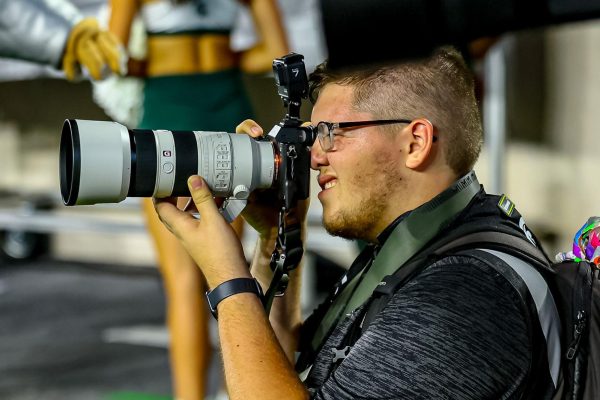

CHICAGO, Ill. – Similar to the Michigan State men’s basketball coaching staff, our crew kept a close eye on Thursday night’s Big Ten Tournament Third Round contest between UCLA and Rutgers, as the winner advances to the Quarterfinals to play Michigan State.
The Spartans had regular-season success against both teams, winning both games against Rutgers by a narrow margin, in overtime on the road, and avoiding a collapse on senior night in East Lansing.
MSU also hosted UCLA in February, when the Spartans coasted to an 82-59 win, which ignited the iconic clip of Bruins head coach Mick Cronin in the bowels of Breslin Center.
The 14 seed Scarlet Knights hung in with the 6 seed Bruins for most of the game until UCLA pulled away late for the 72-59 victory.
UCLA guard Donovan Dent is known for his scoring capabilities. However, against Rutgers, he did everything else en route to a triple-double. The 6-foot-2 guard led the Bruins in rebounding (10) and assists (11).
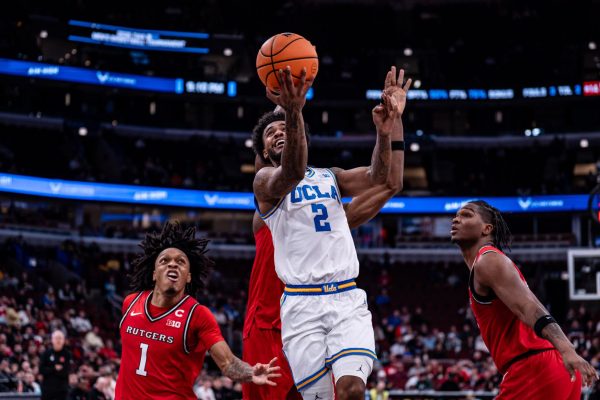
Dent’s triple-double is just the third in a major conference tournament since 1996-97 and the first occurrence in the Big Ten Tournament.
“I didn’t know until the under four media timeout, and one of my teammates was like you’ve got to get one more rebound. I was hunting for it there at the end for sure,” Dent said.
With a team struggling in rebounding, UCLA will need its star guard to crash the glass against the Spartans’ prolific rebounding attack, which ranks first in defensive rebounding percentage (79.8 percent).
“Now I’m going to lie to him for sure so he’ll keep rebounding. I’m going to tell him you need two for a triple double, and he’ll keep rebounding,” Cronin said.
Dent played all 40 minutes for the Bruins on Thursday and will have less than 24 hours to recover before playing the Spartans’ pesky perimeter defense.
Bruins senior forward Tyler Bilodeau led the Big Ten in three-point percentage, converting from deep at a 42.9 percent clip in the regular season. The senior had a game-high 21 points in the third-round victory.
Bilodeau’s play style is comparable to MSU forward Jaxon Kohler, but is quicker laterally and uses less physicality.
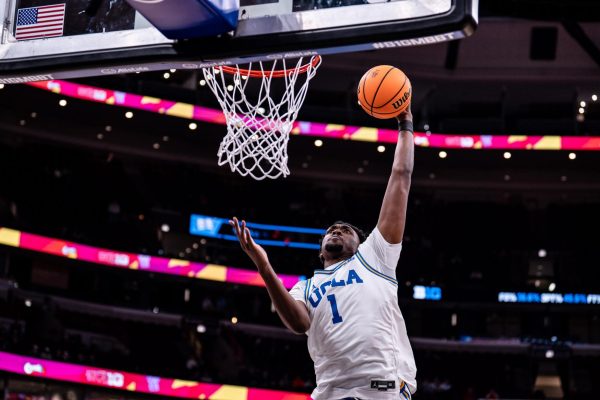
Former Spartans forward Xavier Booker has seen a reduction in his role with the Bruins; he’s played an average of nine minutes in the final three regular-season games before he got 15 minutes of action against Rutgers.
This will be the first-ever matchup between Michigan State and UCLA in the Big Ten Tournament and the first postseason matchup between these two historic programs since the First Four in 2021 (Don’t mention free-throw cut-outs to Tom Izzo).
Here we go, now it’s time. Let’s dive into the X’s and O’s of this UCLA group:
Under Cronin’s tenure, UCLA has built a roster centered around experienced guard play, efficient perimeter shooting, and a defensive system capable of shifting between multiple coverages.
For Michigan State, slowing down UCLA will start with containing the Bruins’ experienced backcourt.
A backcourt led by one of the conference’s best
Like Rutgers, UCLA thrives on quick guard movement and perimeter creation. The difference lies in experience. The Bruins rely heavily on veteran decision-making in the backcourt, led by Dent, who serves as the engine of UCLA’s offense.
Dent’s ability to control tempo allows the Bruins to stay composed in half-court situations. Whether initiating through ball screens or pushing the ball in transition, he consistently creates opportunities for teammates.
For Michigan State, the defensive focus begins with limiting Dent’s ability to initiate offense comfortably. Expect the Spartans’ guards to apply ball pressure early in possessions and force the Bruins into secondary options before their offense can fully develop.
Bilodeau can make magic on all three levels
A huge part of the Bruins’ scoring comes from Bilodeau. The versatile forward averages 18.0 points per game, ranking 10th in the conference. Bilodeau’s role varies from game to game, but most often he functions as UCLA’s primary scorer while working alongside Dent to generate inside-out opportunities.
When Bilodeau establishes position on the block or receives the ball in face-up situations near the elbow, UCLA’s offense opens up considerably. If defenses collapse on his drives or post touches, the Bruins immediately look to kick the ball out to perimeter shooters.
This is where Michigan State’s weak-side defense becomes critical
When the entry pass goes into the post, Spartan guards will likely hedge toward the block before recovering to shooters on the perimeter. The goal is to briefly crowd Bilodeau and disrupt his decision-making without allowing UCLA’s shooters clean catch-and-shoot looks.
That philosophy becomes especially important considering UCLA’s efficiency from deep.
The Bruins finished second in the conference in three-point percentage during the regular season, shooting 38.2 percent from beyond the arc.
Sneaky “X-Factors” for UCLA
Two players who can quietly swing games for UCLA are junior forward Eric Dailey Jr. and senior guard Skyy Clark. Dailey provides length and athleticism on the wing while contributing as a secondary scoring option, while Clark offers another reliable ball-handler capable of creating shots both on and off the ball.
If Michigan State’s defense collapses too aggressively on Dent or Bilodeau, players like Dailey and Clark become dangerous secondary scoring options on the perimeter.
Diving deeper into the Bruins’ offensive structure, one set appears frequently throughout the game.
UCLA often operates out of a “four wide” or “4–1” alignment. The set places four shooters around the perimeter with a single forward positioned inside the paint or near the high post.

The goal of the set is simple: create spacing.
With the floor spread, guards like Dent and Clark can attack downhill while forcing defenders to cover the entire width of the floor. Once the defense collapses toward the rim, UCLA immediately looks to generate open perimeter shots.
To counter this spacing, Michigan State will likely rely on disciplined help-side rotations from not only its guard play, but also Cooper, Kohler and Carr. When the initial defender is beaten off the dribble, especially in pick and roll sets, the wings must rotate quickly to cut off driving lanes while still recovering to shooters along the perimeter.
But the Bruins’ offense does not stop there
Cronin’s group will often transition from the four-out alignment into a high-low set involving multiple frontcourt players. In this sequence, one forward flashes to the elbow while another establishes position on the block.
Players like Dailey Jr. rotate through these roles, creating vertical spacing within the offense. The forward at the elbow can feed the post directly, attack the rim himself, or kick the ball back out if the defense rotates.
When the high-low action works effectively, UCLA forces the defense into difficult two-on-one decisions in the paint, with mainly Dailey Jr. and Bilodeau on the receiving end.
For Michigan State, communication between its big men will be essential in defending this action. The Spartan frontcourt must prevent the entry pass from the elbow while also maintaining positioning on the block to avoid easy interior baskets.
Defensively, the Bruins bring a similar level of versatility
Cronin’s teams have long been known for their defensive discipline, and UCLA is capable of switching between several coverages throughout a game. One look that frequently appears is a traditional 2-3 zone.
The Bruins’ version of the zone works well because of their combination of length and quickness on the perimeter.
Guards apply pressure at the top of the formation, disrupting passing lanes and forcing opponents to make quick decisions. Meanwhile, UCLA’s wings patrol the baseline, allowing them to contest corner three-point attempts while still protecting the rim.
To attack the zone, Michigan State will need consistent ball movement and high-post touches. When the ball reaches the middle of the floor, the Bruins’ zone can begin to collapse, opening opportunities along the baseline or for kick-out threes.
The Bruins’ aggressive defense has helped them rank fifth in the conference in steals per game at 6.3, while they also protect the basketball offensively, committing just 9.0 turnovers per game during the regular season.
One area where UCLA has struggled this season is on the glass
The Bruins ranked 14th in the conference in rebounds per game at 22.2, which could allow for a group in MSU that grabs 40.0 rebounds per game (3rd in B1G). Still, when UCLA’s spacing offense is flowing and its defensive rotations are sharp, the Bruins can quickly dictate the pace of a game.
For Michigan State, success will likely come down to defensive discipline, rebounding, and limiting UCLA’s perimeter shooting opportunities.
With experienced guards, efficient spacing, and a versatile defensive scheme, the Bruins remain one of the more difficult teams in the conference to prepare for. However, with the Spartans already seeing the Bruins once this season, familiarity with their Friday night foe will be on each team’s side.
OPINION: The way each team could win
Jack: For Michigan State, the first five minutes will tell a lot. If the Spartans can see an early double-digit lead (within the first seven minutes), they could be primed for a semi-final matchup.
The other key piece to the puzzle is limiting turnovers. In BTT history, where MSU has won 2+ games or more, the Spartans are able to see their turnover rate go below the season average.
In the 2019 Final vs. Michigan, MSU recorded only 7 turnovers. 2014 Semifinal vs Wisconsin: 6 turnovers. 2012 Final vs Ohio State: 8 turnovers
For UCLA, you need to control the pace at least 70% of the game. We have seen many performances from MSU this season in which the Spartans get outmatched early, and have trouble climbing back (Ex., @ Wisconsin, vs Michigan at home, @ Rutgers).
Play through Donovan Dent. If he can get to the rim and navigate ball screens, the Bruins’ offense could flourish against a Spartan defense that has the potential to get exploited. Especially in ball screen coverage.
The final piece for UCLA may not have much “jazz” or “flash” to it, but it’s quite simple. Hit shots. For a group that has gone through its hot/cold streaks all season, if the Bruins see their FG% and 3PT% be higher than season average (47.2% and 38.2%), I’m sure you can do the math. Good things happen.
Tim: The first ten minutes are vital. Coming off four days of rest and a frustrating loss, it can go one of two ways for MSU. The loss on Sunday can either spark a focused stretch of practices that they can carry over to tip-off or those frustrations from Ann Arbor can linger with the team in Chicago.
The Spartans need to replicate their regular-season win over UCLA, when they jumped out to a double-digit lead in the first nine minutes.
On the other hand, the Bruins could pounce on a sluggish beginning for the Spartans, building on the momentum from their tournament win already under their belt.
Let’s see what the freshman can offer. MSU freshman forwards Jordan Scott and Cam Ward have become more important as the rotation shallows. The pair have accumulated big-game experience in their young career, but have never played in a win-or-go-home atmosphere.
UCLA concurrently relies on a short rotation, but Cronin doesn’t have the same dilemma as Izzo, having to lean on lesser-experienced players.
If UCLA can stop the Spartans from an early start and production from freshmen, the possibility of a semifinal berth in reach.
Tip-off for the Big Ten Tournament Quarterfinal is set for 9 p.m. at the United Center in Chicago, Ill. Catch Jack Stager and Joe Dez on the radio broadcast for Impact 89FM streaming live here: https://impact89fm.org/listenlive/