Many musical performances are guided by sheet music, time signatures and keys. For students in Michigan State University’s electronic music workshop course, however, these guidelines are less conventional.
“We are really used to playing pieces where, instead of a traditionally notated musical score, we often use things like pictures, images or poetry to make music,” Anthony T. Marasco, Assistant Professor of Composition and Technology and co-director of MSU’s electronic music workshop said. “It really opens up, for our students, the availability to say: your art can look very different and sound very different than you might expect, or have been told it should.”
This fresh and flexible approach to music performance was recently brought to one of MSU’s most popular creative hubs, the Broad Art Museum.
On Tuesday March 24, Broad hosted the Sightlines and Soundscapes event. This semesterly event features student performers from the electronic music workshop who perform pieces that interact with the art on display in the museum.
“The event that we’re doing with the Broad allows us to go and pick pieces of art or exhibitions … and write pieces of music that are brand new,” Marasco said. “These groups have kind of been working on: OK, what should our piece be, based on the work that’s here and based on the architecture of the rooms?”
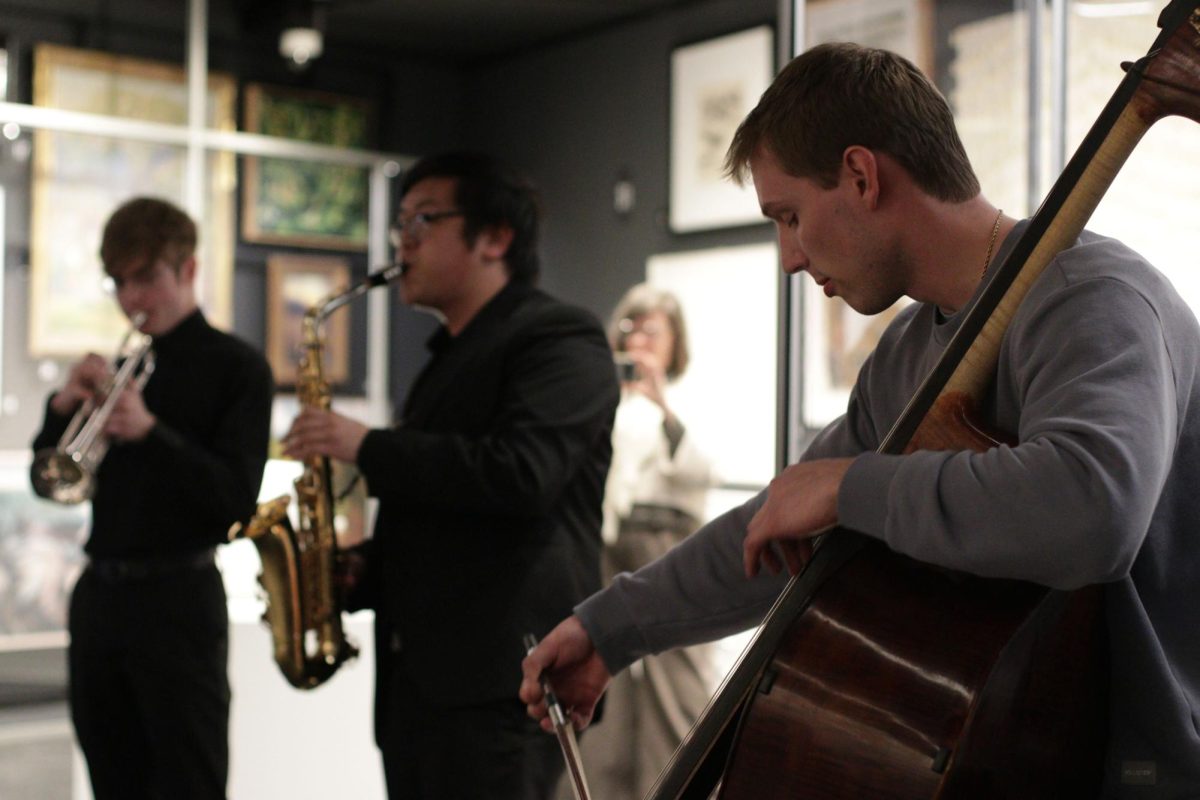
The performances of the Sightlines and Soundscapes event spanned multiple spaces and exhibits across Broad. Audiences were led from room to room to witness how student performers interpreted the museum’s art with a wide array of instruments, both electronic and acoustic, including electric guitar, harp and synthesizer.
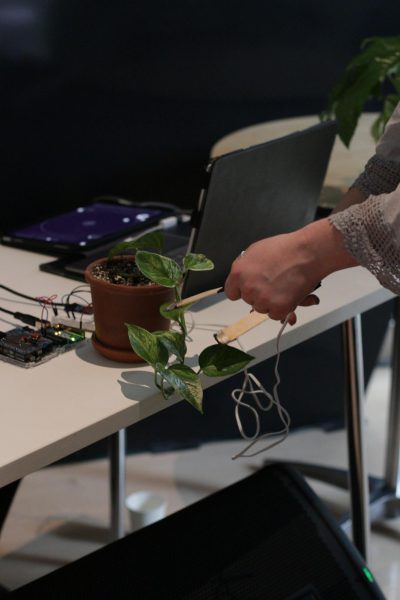
Audience members were given the opportunity to move freely around the performers and rooms. At one exhibit, observants could even become part of the ensemble themselves.
For example, one exhibit featured a table with two potted plants, a student performer’s computer and popsicle sticks connected to it by wire. Participants from the audience touched the popsicle sticks to various parts of the plants. The computer picked up the plants’ internal electrical fluctuations and translated them to synthesized sound, which then played through attached speakers.
Marasco said he believes that Broad’s open architectural design makes the space highly conducive for these kinds of unique, interactive audience experiences.
“It allows the audience to, in that space, move around us and hear us from different positions acoustically,” Marasco said. “Being able to come to a space like Broad that invites you to look at things, touch things, see things from different angles … it gives us the opportunity to present music that fits that bill.”
The electronic music workshop that puts together the Sightlines and Soundscapes performance each semester used to be student-run, but it’s been a faculty-run course for several years now. The class meets weekly to work together on the shared experience of free improvisation.
Alexis Bacon is an Associate Professor of Music Composition and co-director of the workshop.
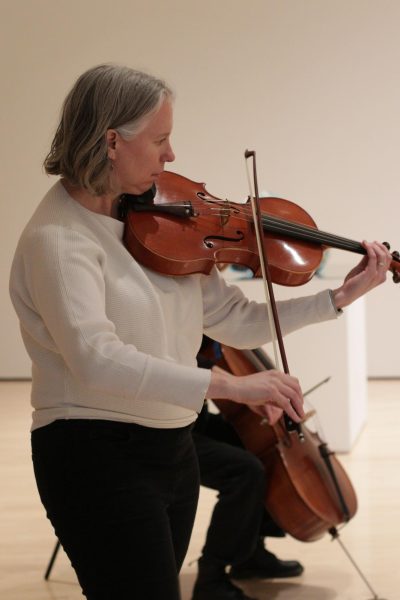
“A lot of our rehearsal time looks like discussion,” Bacon said. “We try things out, and then we talk about what we thought… We’re not trying so much to, you know, represent a composer’s vision, we are responding to one another in the moment.”
Bacon emphasized the highly collaborative elements of the workshop group, both in their weekly rehearsals and their ensemble performances.
“It’s a really sort of flat hierarchical structure,” Bacon said. “Sometimes [students] are doing it because they have a particular requirement to fill, but they’re equal partners … their voices count equally, their ideas count equally.”
Another form of collaboration that the Sightlines and Soundscapes event brought was when Jan Tichy, an artist whose “Darkness” exhibit is on display at Broad, came to one of the workshop’s rehearsal sessions to see how students were interpreting his art.
“He doesn’t typically work with sound,” Bacon said. “We talked a little bit about what that meant to have sound with something that wasn’t conceived of with sound. He had to think about what he was doing with his art after hearing how we were interpreting it.”
The electronic music workshop course is open to students from all majors and departments, requires no prior musical experience to join and can be taken for multiple semesters.
For example, Henry Holcomb, a senior studying game development, played guitar for the interactive plant exhibit. They said that they were drawn to the course by the passionate faculty who direct and support it, as well as the freedom that comes with the musical improvisation that the course highlights.
“I actually played jazz trumpet for a long time, and I think the one thing that spoke to me was when there was, like, no rules.” Holcomb said. “The more and more that I get into music, the more intuitive I try to be with it. Space is where the magic happens, because just thinking and letting it wash over you is more important than playing cool solos or cool licks or anything like that.”